Do Outrage Hooks Work for App TikToks?
Six outrage-style app TikToks broke out at 636x to 1,766x. Only two made people ask for the app. The difference was a personal stake the app solved on screen.

Updated 25 November 2026.
Short answer: Outrage hooks get reach in every niche, but they only sell an app when the outrage is personal and the app resolves it on screen. Of six outrage-style app posts in Handler's library with a comment read, all six beat their account's usual views by 636x to 1,766x, and only two drew people asking for the app. Both stated a real budget up front and showed the app beating it. When the anger was aimed at a brand, at the viewer, or built on a false claim, the comments argued with the post instead of asking where to download.
Key points
- @mealswith.bri opened on "I'm sorry ALDI WHAT?!?", set a $100 weekly budget for four, and landed on $58. It reached 1.1M views against about 625 typical (1,766x), and the top comment was "What is this app?!"
- @alexainvestss posted deliberately wrong budget math for a finance app. It reached 946K views (1,055x) and 1.6K comments, almost all of them correcting the numbers, with zero interest in the app.
- @oliviamartinez0729 reached 4.8M views (636x) with a false claim that anyone can watch your FaceTime camera. The comments were people asking if it was real.
- Store-callout posts for Woolworths and Trader Joe's broke out too, but drew reach and saves rather than install questions.
- The pattern to copy: anger about a problem the viewer has, a stake stated in the first few seconds, and a number the app produces on screen.
What is an outrage hook?
An outrage hook opens a TikTok on anger, disbelief or a callout, before the real content starts. On app TikToks it takes four common forms: a callout of a store or brand ("Trader Joe's, are you joking?"), rage bait that is wrong on purpose to pull corrections, a fake controversy about a real company, and a staged personal drama. All four stop the scroll. What they do after the first two seconds decides whether anyone wants the app.
Do outrage hooks work for app TikToks?
They work for reach. They work for installs far less often. Here are the six outrage-style posts we have comment reads for, from meal planning, finance and phone tracking apps.
| Post | Opener | Personal stake stated? | App resolves it on screen? | Outlier | Pull | Comment read |
|---|---|---|---|---|---|---|
| @mealswith.bri | "I'm sorry ALDI WHAT?!?" | Yes: four people, $100 a week | Yes: $58 | 1,766x | 5/5 | Install intent |
| @brooke.cooks7 | "$50 for 6 is crazy" | Yes: $50 for six | Yes: a week under $50 | 640x | 3/5 | Install intent |
| @paula.eatss | Woolworths callout | No | Partly: a budgeting demo, no target | 962x | 5/5 | Awareness |
| @smallbizshy | Trader Joe's callout | No | Yes: seven dinners for $54 | 728x | 3/5 | Awareness |
| @alexainvestss | "yall should NOT be struggling" | No, aimed at the viewer | No | 1,055x | 3/5 | Corrections only |
| @oliviamartinez0729 | "apple pls explain" | No, a false claim | Shows a live camera view | 636x | 5/5 | Panic and doubt |
The two posts with install intent are the only two that stated a personal stake in the opening seconds and then beat it on screen. The Trader Joe's post shows a number too, seven dinners for $54, but its hook never stated a personal budget. Commenters argued with the total and the paywall instead. We covered four of these meal planning posts in How to Grow a Meal Planning App on TikTok.
If the scores are new to you, What Is a Good View Count on TikTok? explains the baseline, and What Counts as a Winning TikTok for a Mobile Game? explains Outlier and Pull in more depth.
Teardown 1: "I'm sorry ALDI WHAT?!?" (1,766x)
A store callout that turns into a family budget, beaten on screen by almost half. See the full breakdown.
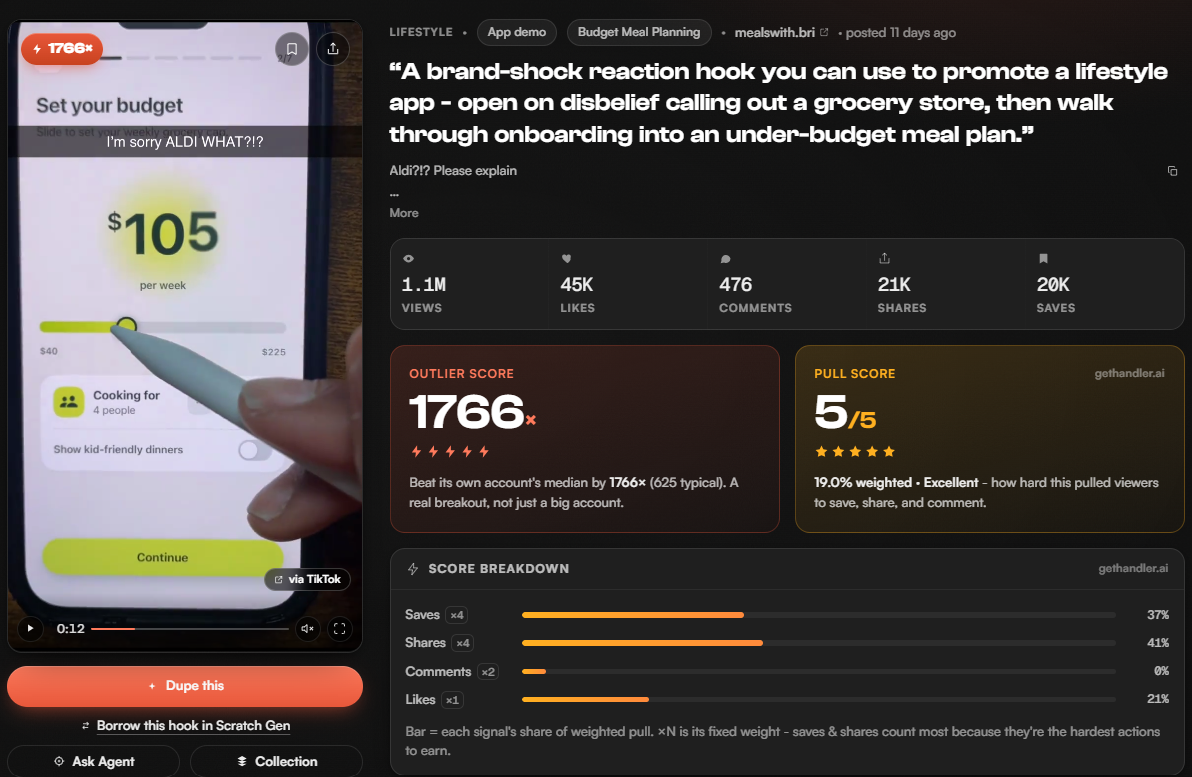
What happened. @mealswith.bri posted this on 14 November 2026. It reached 1.1M views on an account that normally gets about 625. It earned 45K likes, 476 comments, 21K shares and 20K saves, for Pull 5/5 (19.0% weighted). Shares and saves made up 41% and 37% of the weighted pull. The caption reads "Aldi?!? Please explain." The 55-second video is a voiced walkthrough of Whipp, a meal planning app, filmed over the shoulder. The setup is fast: the family shops at Aldi, there are four of them, and they try to keep it around $100 a week. The poster sets the budget slider, picks the appliances they own, rules out what the kids won't eat and anything spicy. The app checks Aldi prices, and the poster reacts to the total: $58.
Why it likely worked. This is our reading, not something the data proves. The outrage is fake in the best way. It sounds like a complaint about Aldi, but it is really disbelief at how cheap the plan came out. Aldi shoppers already care about price, so the name pulls in the right audience. The stake is personal and specific, and the onboarding choices (four people, the kids, the crock pot) let viewers see their own household. The payoff is a number well under the target. Handler reads the comments as heavy install intent. The top comment asked what the app was, and others compared it with free tools.
How to rebuild it. Open on a reaction to a store your users shop at, then state your own budget and household in one breath. Walk through the setup steps that make the plan personal, and end on the number your app produces.
What to change for your app.
- Make the stake yours: a real budget, a real household, a real store.
- Show the app's name early and clearly. "What is this app?!" as the top comment is a good sign, but it also means people couldn't tell.
- Expect comparisons with free tools. Say what is free in your app before the comments do.
- Keep the anger playful. Disbelief at a great result reads better than a complaint about a brand.
Teardown 2: "$22 an hour, you should NOT be struggling" (1,055x)
Deliberately wrong budget math for a finance app, built to pull corrections.
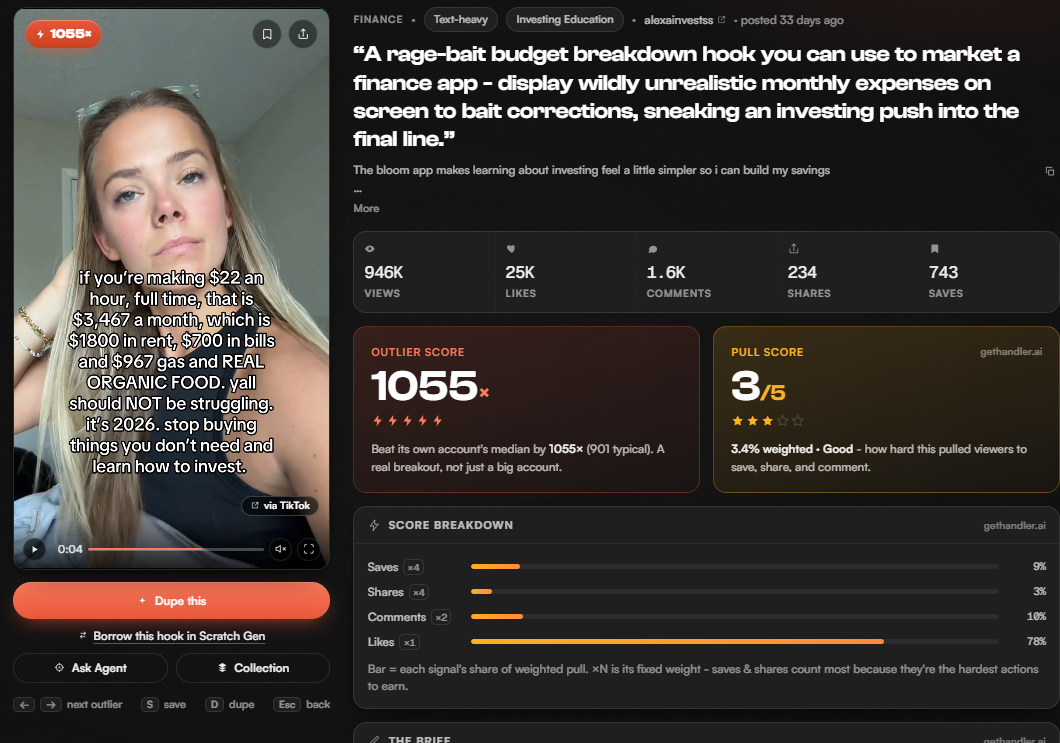
What happened. @alexainvestss posted this on 23 October 2026. It reached 946K views on an account that normally gets about 901. It earned 25K likes, 1.6K comments, 234 shares and 743 saves, for Pull 3/5 (3.4% weighted). Comments made up 10% of the weighted pull, the highest share of the three teardowns. The video is a selfie with a block of text. It claims $22 an hour full time works out to $3,467 a month, splits that into rent, bills, gas and organic food, then says viewers shouldn't be struggling and should learn to invest. The caption credits the Bloom app for making investing simpler.
Why it likely worked. This is our reading, not something the data proves. The math is wrong and the tone is condescending, so viewers rush to correct it. That produces comments and reach. But Handler reads the comment section as "an angry correction hivemind" with zero interest in the app. People listed insurance, taxes, kids and utilities the budget left out. The app sits in the caption, after the argument has already started.
How to rebuild it. We wouldn't rebuild this one for a finance app. Wrong math on purpose makes your app look careless with money, which is the opposite of what a finance app needs. If you want the reach, use a budget that is realistic but surprising, and let your app show the real breakdown.
What to change for your app.
- Get the numbers right. Comments that correct your math are comments that doubt your product.
- Put the app in the video, not just the caption, and let it do the calculation.
- Don't lecture the viewer. Aim the frustration at the problem, like prices or fees, not at the people you want as users.
- Read How Finance Apps Grow on TikTok Without Risky Claims before you post money claims of any kind.
Teardown 3, a cautionary one: a false FaceTime claim (636x)
A made-up Apple controversy, then a live camera view on a second phone.
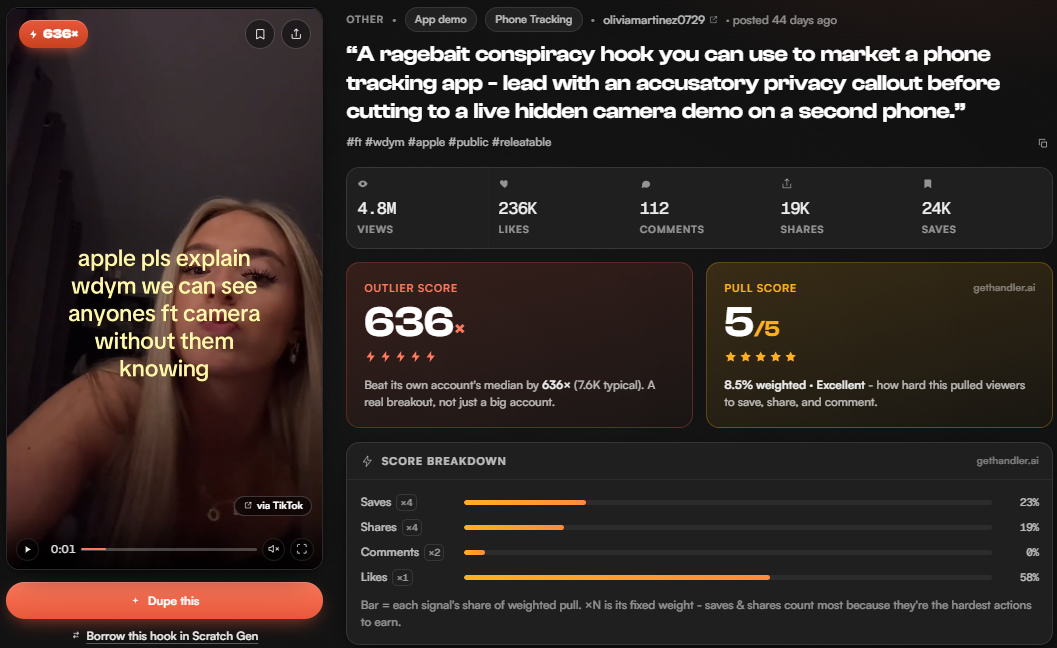
What happened. @oliviamartinez0729 posted this on 12 October 2026. It reached 4.8M views on an account that normally gets about 7.6K. It earned 236K likes, 112 comments, 19K shares and 24K saves, for Pull 5/5 (8.5% weighted). The on-screen text asks Apple to explain how anyone can see your FaceTime camera without you knowing. It cuts to a hand tapping "View Live" on a second phone. The post promotes an unnamed phone tracking and camera monitoring app.
Why it got reach. This is our reading, not something the data proves. Handler's brief describes the hook as a fake security loophole framed as an urgent Apple controversy. Fear about privacy is universal, so people stopped, replayed the screen, and sent it on. That explains the shares and saves.
What the comments show. Handler reads the room as genuine panic and technical doubt. People begged to hear it was fake, others said it isn't possible, and the thread became a debate about whether the clip was real. Few asked where to get the app.
Why we wouldn't rebuild it. It makes a false claim about a real company, it scares viewers, and it presents watching someone's camera without their knowledge as a feature. Even judged only on results, the reach did not turn into install intent.
The honest version. If you build a privacy or security app, aim the alarm at something real and checkable. Show a setting viewers can open on their own phone, like which apps have camera access, and let your app do the checking. Real fear that your app resolves is the same structure as Teardown 1, without misleading anyone.
Where do outrage hooks cross the line?
Staged drama shows up most in apps that search dating profiles or run background checks.
| Post | App type | What it does | Outlier | Views | Typical views | Pull |
|---|---|---|---|---|---|---|
| @lenainlove1 | Background check | A staged caught-cheating prank, with in-app dating profile search shown late | 22x | 8.5M | about 512K | 5/5 |
| @isla.kove | Cheater detection | A staged hidden-camera argument, with dating profile results shown mid-fight | 34x | 4.4M | about 150K | 3/5 |
The view counts are huge, but the multiples are small, because these accounts already get hundreds of thousands of views. The format is filling an existing audience, not breaking a new one.
Outrage hooks cross the line when they:
- Make a false claim about a real company. "Apple lets anyone watch your camera" is not a hook, it's misinformation.
- Stage an accusation and present it as real. A skit is fine. A fake confrontation passed off as real footage misleads viewers.
- Sell surveillance of someone without their knowledge. Monitoring another person's phone or camera covertly is the problem, not the marketing angle.
- Hide that the post is an ad. Commenters called two of the meal planning posts undisclosed ads, and that criticism took over their threads.
- Get the numbers wrong on purpose for a money product. It wins comments and loses trust.
How do you write an outrage hook that sells?
- Aim the anger at a problem your viewer has, like prices, fees or wasted time, not at the viewer.
- State a personal stake in the first few seconds, a budget, a household or a goal, so viewers can compare it with their own.
- Let the app resolve it on screen with one number: a total, a saving or a time.
- Name the app on screen, so the comments ask how to get it, not what it is.
- Say what is free before the comments do. Price questions came up in three of the meal planning threads, and paywall complaints took over one.
- Read the comments, not just the Pull Score. Corrections and "is this real?" are reach. "What is this app?" is intent. We saw the same split in dating apps, covered in How to Grow a Dating App on TikTok.
Before you shoot, test the idea against the VSC framework. After you post, use Kill, Mutate or Scale to decide what to keep.
How can you rebuild an outrage hook with DupeFarm?
- For the opener, use a Premium Dupe: a fresh take on the winner with your AI creator, and an optional voiceover for the reaction and the stake. Swap in a store and a budget your users recognize.
- For the over-the-shoulder demo, use a Motion Dupe, which copies the source clip's exact movement. Motion Dupes are always silent, so add your sound natively in TikTok.
- For the payoff, put the final number in the overlay kit, which comes as a separate layer with your caption, hashtags and "#ad" where needed.
How a TikTok Dupe Works in Handler, Start to Finish walks through each step. If an AI creator fronts your posts, Can an AI Creator Front Your Fitness App's TikToks? covers TikTok's labeling rules, which apply to every niche.
What does this data not show?
- Installs. We can see comments, not downloads. Install intent in the comments is a signal, not a sign-up count.
- Sample size. Six posts with comment reads, mostly meal planning. The personal-stake pattern held across all six, but six posts can't prove it.
- Comment reads for the staged drama posts. We have scores for those two, not comment reads, so we can't say what their audiences wanted.
- Paid boosts. We cannot tell whether any post was promoted with ads after it started to break out.
FAQ
What is an outrage hook on TikTok? An outrage hook opens a video on anger, disbelief or a callout before the real content starts. On app TikToks it usually takes one of four forms: calling out a store or brand, rage bait that is wrong on purpose, a fake controversy about a company, or a staged personal drama.
Do outrage hooks work for app TikToks? They work for reach, and they work for installs far less often. Six outrage-style app posts in Handler's library beat their account's usual views by 636x to 1,766x, but only two drew install intent in the comments. Both stated a personal budget up front and showed the app beating it on screen.
Why don't rage-bait comments turn into installs? Because the comments are about the outrage, not the app. A finance post with deliberately wrong budget math drew 1.6K comments, and Handler found almost all were corrections, with zero interest in the app. Comments only signal intent when people ask what the app is or how to get it.
Is it okay to call out a real brand in an app TikTok? A playful reaction to a store's prices is common, and the top-scoring post in this teardown did exactly that with Aldi. Making a false claim about a company is different. A post claiming Apple lets anyone see your FaceTime camera reached 4.8M views, but its comments were people asking whether it was real.
How can I tell if an outrage post will drive installs? Read the comments. "What is this app?!" means intent. Corrections, arguments and "is this fake?" mean reach only. Handler reads each post's comments and flags whether the audience shows real install intent.
How do I find outrage hooks that are winning in my niche? Paste your App Store link into Handler. It pulls the TikToks breaking out in your niche, scores each one by Outlier and Pull, and reads the comments on each. You can also browse the public lifestyle outlier library or run your own posts through the TikTok Outlier Calculator.
See the scores for your niche
Handler finds the outlier TikToks winning in your niche, scores them, and rebuilds the winners as on-brand videos with your own AI creator. Every pick comes with a comment read, so you rebuild the posts that drive installs, not just the ones that start arguments. Your first 6 picks are free, no card. Start free at gethandler.ai. Handler comes from the team behind Flamme, which grew to 200k+ users and 50M+ organic TikTok views with zero paid spend.
How we measured
- Outlier Score: a post's views divided by its account's median views. 1,766x means the post got 1,766 times the account's usual views.
- Pull Score: weighted pull from saves and shares (4x each), comments (2x) and likes (1x), rated 1 to 5. It is the quality gate, so a post with big reach but weak pull scores low.
- Comment read: Handler reads each post's comments and labels whether the audience shows real install intent.
- Source and scope: Handler's research library, searched for outrage, rage-bait and drama openers across niches, posts from 12 October to 16 November 2026, all read on 25 November 2026.