What Is a Good View Count on TikTok? Full 2026 Guide


There is no universal "good" view count on TikTok. A good view count is one that beats your own account's normal, not a fixed number like 10,000 or 1 million. The right way to judge any post is against your baseline, the median views your account typically gets, since the same 50,000 views can be a flop for one account and a breakout for another.
Updated August 2026
Your baseline, not a magic number
Most "what's a good view count" answers online give you a flat number, something like "10K views is good for a small account." That number is close to useless on its own, because it ignores the one variable that actually matters: what does your account normally get?
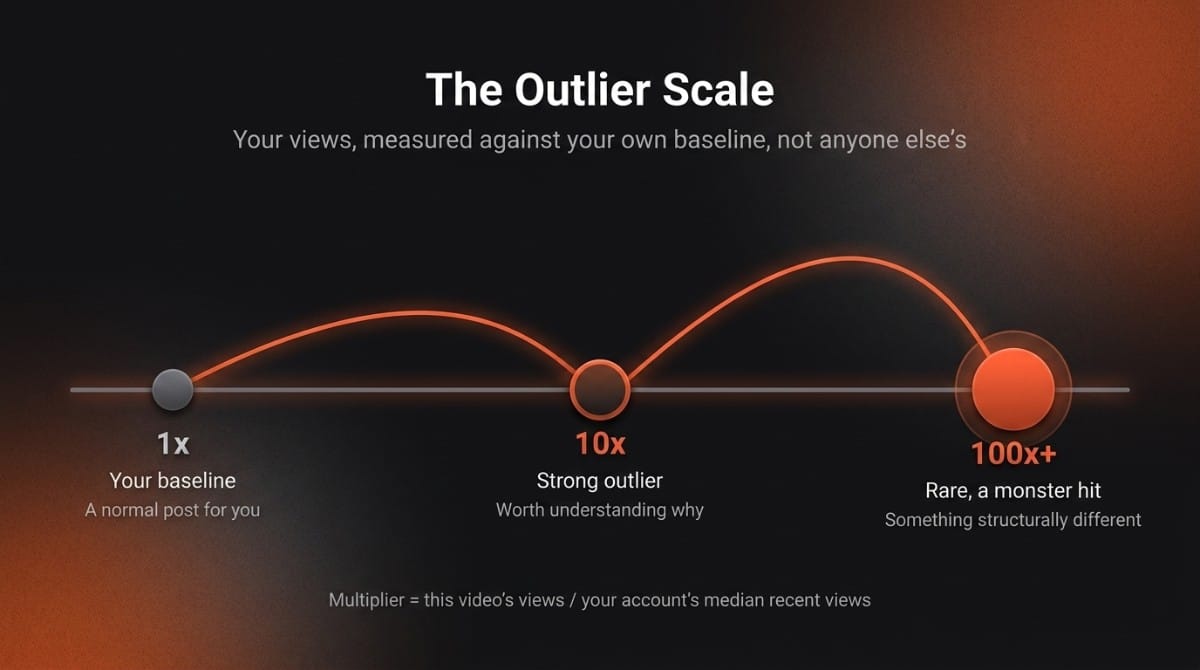
Here is the scale we use to read any post against that baseline, called the Outlier Score. It is simply that video's views divided by your account's median recent views.
| Multiplier | What it means | Read on it |
|---|---|---|
| Around 1x | A normal post for you | Not a signal either way, this is just your baseline doing its job |
| Around 10x | A strong outlier | Something in this post is worth understanding and repeating |
| Around 100x+ | Rare, a monster hit | Structurally different from your normal content, dig into why |
A 50,000-view post is a strong outlier for an account that usually gets 5,000 views. The same 50,000-view post is below baseline for an account that usually gets 300,000 views. Same number, opposite read.
How to actually find your baseline
Finding your baseline takes three steps, and most founders skip step two, which is exactly where the mistake happens.
- Pull your last 15-20 posts. Not your best posts, your most recent ones, in order. Cherry-picking your highlights defeats the purpose.
- Take the median, not the average. This is the step most people get wrong. One 2-million-view fluke in your last 20 posts will drag an average way up and quietly hide every other post's real performance. The median, the middle value when you line up your posts low to high, ignores that fluke completely.
- Recalculate every few weeks. Your baseline moves as your account grows. A number from six months ago on a smaller account is not your baseline anymore, it is history.
If you want to skip the manual math, our free TikTok Outlier Calculator does steps 1 through 3 for you, drop in your recent posts and it returns your baseline and flags anything that clears the outlier line.
Why most founders get this wrong
Three mistakes show up over and over when people try to eyeball this instead of calculating it.
They compare to other accounts, not their own. Watching a bigger account's numbers and trying to hit the same raw view count is a different exercise entirely. Their baseline is not your baseline, and chasing their number tells you nothing about whether your own content is actually working.
They use average instead of median. Covered above, but worth repeating because it is the single most common error. One viral fluke early in an account's life can make every post afterward look like it is underperforming, when really the account never had that "normal" to begin with.
They treat a single good post as a new baseline. One outlier does not reset what "normal" looks like for your account. Your baseline only moves once a new pattern shows up across multiple posts, not after one lucky hit.
What to do once you know your baseline
Knowing your baseline is only useful if you act on it. Once you have it, use it to sort your own back catalog into three buckets: normal posts, strong outliers, and posts that underperformed. The outliers are your format library, the specific hooks, structures, or topics that beat your normal, worth repeating on purpose instead of by accident.
View count alone will not tell you if an outlier is a fluke or a real signal though. Pair the multiplier with an engagement check, since a post that clears 10x baseline but gets almost no comments or shares is a different kind of win than one that clears 10x and gets people actually reacting. Our free TikTok Engagement Rate Calculator gives you that second number in a few seconds, so you are reading views and engagement together instead of views alone.
This two-number habit, baseline multiplier plus engagement rate, is also the exact starting point behind The VSC Framework, our full process for deciding which outlier ideas are actually worth rebuilding into new content versus which ones just happened to get lucky once.
FAQ
What is a good view count on TikTok?
There is no fixed good view count on TikTok. A view count is good when it beats your own account's baseline, the median views your account typically gets on its last 15-20 posts, not when it hits some universal number. The same view count can be a strong outlier for a small account and an underperformer for a large one.
How do you calculate your TikTok baseline?
Pull your last 15-20 posts in order, then take the median view count, the middle value when the posts are sorted low to high, rather than the average. Using the median instead of the average avoids letting one viral fluke distort what "normal" actually looks like for your account. Recalculate every few weeks as your account grows.
What counts as an outlier on TikTok?
A post is generally considered a strong outlier around 10x your account's baseline, and a rare, standout hit around 100x or more. Below that range, a post is close to your normal performance and is not a meaningful signal on its own, even if the raw view count looks high.
Does a good view count on TikTok change based on follower count?
Not directly, follower count and baseline views are related but not the same thing. Two accounts with the same follower count can have very different baselines depending on posting consistency and niche, so the multiplier against your own recent median is a more reliable read than comparing follower counts across accounts.
Try it yourself
Stop guessing at what counts as a good post for your account. Run your last few videos through the free TikTok Outlier Calculator and see your real baseline in a few seconds.