TikTok Growth Tools for App Makers: An Honest Guide
The best TikTok growth tool for an app maker is one that shows you which posts in your niche beat their own account's normal views, explains why, and helps you make your own version.
The best TikTok growth tool for an app maker is one that shows you which posts in your niche beat their own account's normal views, explains why, and helps you make your own version with your app on screen. Scheduling, hashtag and follower-analytics tools help at the edges, but none of them answer the question that actually stalls app makers, which is what to post next.
I've been on both sides of this. I grew Flamme to 50M+ organic views before it was acquired by Arya, and now I build Handler, which is one of the tools in this post. So take my bias into account. I'll tell you where Handler is the wrong pick, and I'll describe the other tools using their own words from their own sites.
What app makers need that creators don't
Most TikTok tools are built for creators growing a personal following. App makers have a different job, and it changes what a good tool looks like.
You're not trying to grow one account's follower count. You want installs, and you'll probably run several accounts or work with several creators to get them. The app has to be on screen, or the post can go viral and send you nobody. And you usually don't have a content team. It's you, maybe a co-founder, and a weekend.
That means the bottleneck is almost never posting or scheduling. It's picking formats that already work for apps like yours, then producing enough versions to find the one that hits.
What to look for in a TikTok growth tool
Here's the checklist I'd use, in the order I'd weigh it.
Scores against the account's own baseline
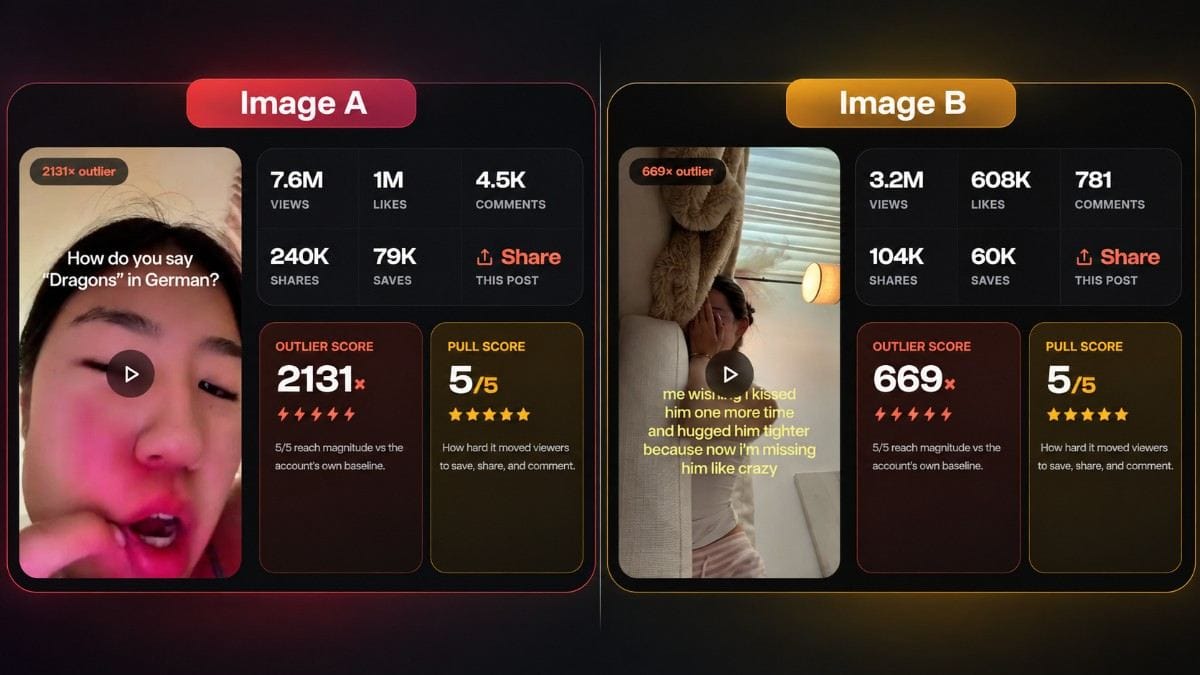
A tool that ranks posts by raw views will fill your screen with big accounts coasting on their size. You want views divided by the account's median, so a 3K-follower account's breakout shows up. For example, this couples widget post did 3.2M views on an account whose median is around 4.8K. That's 669x, and a raw-views ranking would bury it under any celebrity's average post. You can check any post yourself with the free TikTok outlier calculator.
Weighs saves and shares above likes
Likes are the cheapest action on TikTok. Saves and shares are what push a post into more feeds. A good tool weights them heavier. Handler's Pull Score counts shares and saves four times, comments twice and likes once, over a 10,000-view floor. This language learning app demo has 7.6M views, 1M likes and 240K shares. That share count is the part that tells you it would travel.
Filters by app niche, not by hashtag
Hashtags on TikTok are noisy. You want to filter by the kind of app, like calorie tracking or language learning, and by format, like silent UGC, slideshow or app demo.
Tells you why a post worked
A list of big posts is homework. The useful part is the breakdown:
- The hook in the first two seconds.
- How many beats the video has.
- Where the product appears.
- What the comments are asking for.
Gets you to a finished video
Research that ends in a spreadsheet still leaves you to film. If you're not going to film, you need a tool that makes the video, or a budget for creators.
Costs something sane for your volume
A few videos a month and dozens a week are different problems. Price the tool against how many posts you'll actually make.
Six approaches, compared honestly
These are the main ways app makers go about TikTok growth. I've named real tools where one is a clear example of the approach.
1. TikTok itself, plus a spreadsheet
Free. You search your niche, open profiles, write down views on the last 10 posts, take the median, and score posts by hand. I wrote up the full manual method in how to find winning TikToks in your niche. It works. It's slow, it goes stale in a week, and you only find the accounts you thought to search for.
Good for: validating a niche before you pay for anything.
2. Feed-sorting browser extensions
FeedRama describes itself as a Chrome extension that sorts Instagram and TikTok feeds by likes, views and date, downloads and transcribes posts, and exports data to spreadsheets. It's free to install. That's a big time saver on the counting part. You still do the baseline math, the breakdown and the production yourself.
Good for: people who like working in spreadsheets and want the raw data fast.
3. Outlier finders built for creators
ViewRank AI describes itself as a content research tool that finds outlier Reels and TikToks, shows why they worked, and helps you make your own version for your audience. It has a free Chrome extension. The method is close to what I'd recommend. The difference is the audience: it's pitched at creators growing their own channel, so it's not built around an app being on screen or around categories of apps.
Good for: a solo creator, or a founder who is the face of the account.
4. Remix video generators
Riffkit says it works out why a TikTok won (hook, pacing, emotional beats) and rebuilds that formula as an original video with your product, character and language. That's the production end of the job. You bring the winning TikTok, it makes the new one.
Good for: when you already know which posts you want to remake.
5. Creator agencies
Find Me Creators describes itself as a full-service influencer management agency for consumer apps, with a minimum contract of US$100,000. That buys you real human creators and people who run the program for you.
Good for: funded apps that want real faces and have the budget to hand the whole thing off.
6. Research plus AI creators in one tool
This is where Handler sits. It finds outlier TikToks in your app's niche, scores them by Outlier and Pull, explains why each one worked, and then makes your version with an AI creator, with your app on screen. The free outlier library is public if you want to see the research side before signing up.
Good for: app makers who want the research and the production in one place, without filming.
Where Handler fits
Handler is built for one person: someone with a mobile app who wants organic TikTok installs and doesn't have a content team.
The loop goes like this. You tell it your app. It sends you picks from your niche every day (six a day on the free 7-day trial, no card). Each pick comes with the breakdown. Then you pick an AI creator and it makes your version as a finished video. The Chrome extension scores posts on TikTok, Instagram and YouTube while you scroll, so research you do on your own counts too.
Pricing is public. Billed monthly, Starter is $39 a month, Growth is $69 and adds rendered videos with three AI creators, and Pro is $149. Billed yearly, the same plans work out to $29, $49 and $119 a month.
A real example of what it surfaces: this Mise Meal Planner demo did 6.5M views on an account that normally gets about 784, with 196K saves. That's an 8,290x outlier from an account you'd never find by searching "meal planner app". Finding that kind of post fast is the part I'd pay for.
Where Handler does not fit
I'd rather you pick the right tool than churn in a month.
- You want real human creators. Handler makes videos with AI creators. If your brand needs a real person's face, or you want influencer deals, an agency or a creator marketplace is the better fit.
- You're not an app. The niches, the scoring and the breakdowns are built around apps being on screen. A restaurant or a clothing brand will get less out of it.
- You need scheduling or posting. Handler doesn't post for you or manage a calendar. You still upload the videos.
- You want someone to run paid ads. Handler makes the creative. It doesn't buy media or manage ad accounts.
- Your niche is very narrow. Some app categories have hundreds of scored posts in the library, others have a handful. In a thin niche you'll lean on the extension and your own searching more.
- You only have one video in mind. If you already know the one post you want to remake, a remix generator may be all you need.
And one limit every tool shares: public stats only. No tool can see another account's watch time or completion rate. Outlier and Pull are built from views, likes, comments, shares and saves, nothing modelled.
If you want the head-to-head on AI UGC tools specifically, the comparison guides break them down by the job each one does best.
FAQ
What is the best TikTok growth tool for app makers?
The one that matches your bottleneck. If you don't know what to post, pick a research tool that scores posts against the account's own baseline. If you know what to post but can't produce it, pick a video tool. Handler does both for apps, and a free spreadsheet method works if you have more time than budget.
Do TikTok growth tools get you more followers?
Not directly. Research tools help you choose formats that already worked, which raises your odds per post. Followers and installs still come from posting often and posting things people save and share.
Are AI creators allowed on TikTok?
TikTok allows AI-generated content, and it asks you to label realistic AI content using its AI-generated label. Check TikTok's current rules before you post, since they change.
Is Handler only for TikTok?
Handler's research is built around TikTok, and the public outlier library is all TikTok posts. The Chrome extension also scores posts on Instagram and YouTube while you browse.
How much does a TikTok growth tool cost?
From free (TikTok plus a spreadsheet, or a free extension) to six figures (a creator agency with a US$100,000 minimum). Handler is $39, $69 or $149 a month billed monthly ($29, $49 or $119 a month billed yearly), with a free 7-day trial and no card.