Should You Post Every Day on TikTok?
No, not by default. Posting every day is not required to grow on TikTok, and doing it just to hit a quota tends to hurt quality more than it helps reach.

No, not by default. Posting every day is not required to grow on TikTok, and doing it just to hit a quota tends to hurt quality more than it helps reach. The exception is brand-new accounts in their first 30 to 60 days. Past that window, 3 to 5 times a week tends to outperform daily posting sustained over months.
Updated August 2026
This is the blunt version of a bigger question. For the fuller breakdown of cadence by goal, reach or followers, see How Often Should You Post on TikTok?. Here, the focus is narrower: does posting specifically every single day make sense, or not.
The honest answer, no hedging
Most people ask this question hoping for permission to skip a day, and the honest answer is that daily posting was never actually a requirement. TikTok does not reward an account simply for showing up every 24 hours. It rewards content that holds attention, and a rushed video made to hit a daily quota usually holds less attention than a slower, better one would have.
This does not mean frequency is irrelevant, it clearly is not. It means the real trade-off sits between two things that both matter: how many chances you get, and how good each chance actually is.
When daily posting actually makes sense
There are two real exceptions worth knowing.
Brand-new accounts, under roughly 1,000 followers, tend to benefit from posting once or twice a day for their first 30 to 60 days. At that stage the account has almost no algorithmic history, so more attempts genuinely help TikTok learn who to show your content to.
Teams with real production capacity are the other exception. If you can batch-produce a week of genuinely distinct, well-made videos in one sitting, posting one a day looks very different from a solo creator improvising a new video every morning under deadline pressure. The frequency is identical, but the quality gap between those two situations is not.
Why daily posting backfires for most people
Outside those two cases, daily posting tends to work against you in ways that are easy to miss.
Same-day posts can cannibalize each other. When an account publishes more than one video close together, TikTok appears to limit how far the second one travels so it does not compete directly with the first for the same audience's attention. Spacing posts by at least 3 to 4 hours reduces this, but it also means a daily quota rarely produces one clean attempt a day, it often produces several videos quietly splitting the same pool of reach.
Quality also drops faster than most people expect under a daily deadline. Creators who have tested this tend to describe the same pattern: assuming more posts would mean more chances to go viral, then finding the algorithm simply does not reward rushed content, and that one strong video consistently outperforms several mediocre ones made just to hit a quota.
Why TikTok's own guidance says something different
Worth knowing: TikTok's own Creator Portal guidance suggests 1 to 4 posts a day, which is higher than the 3 to 5 times a week that most independent research points to. That gap makes sense once you consider the incentive. TikTok's own advice is written to keep the platform full of fresh content and creators opening the app more often, which benefits the platform regardless of whether it is the optimal pace for any single account. Independent analysis of millions of real posts, without that incentive, consistently lands lower, in the few-times-a-week range.
Quality vs volume, the actual trade-off
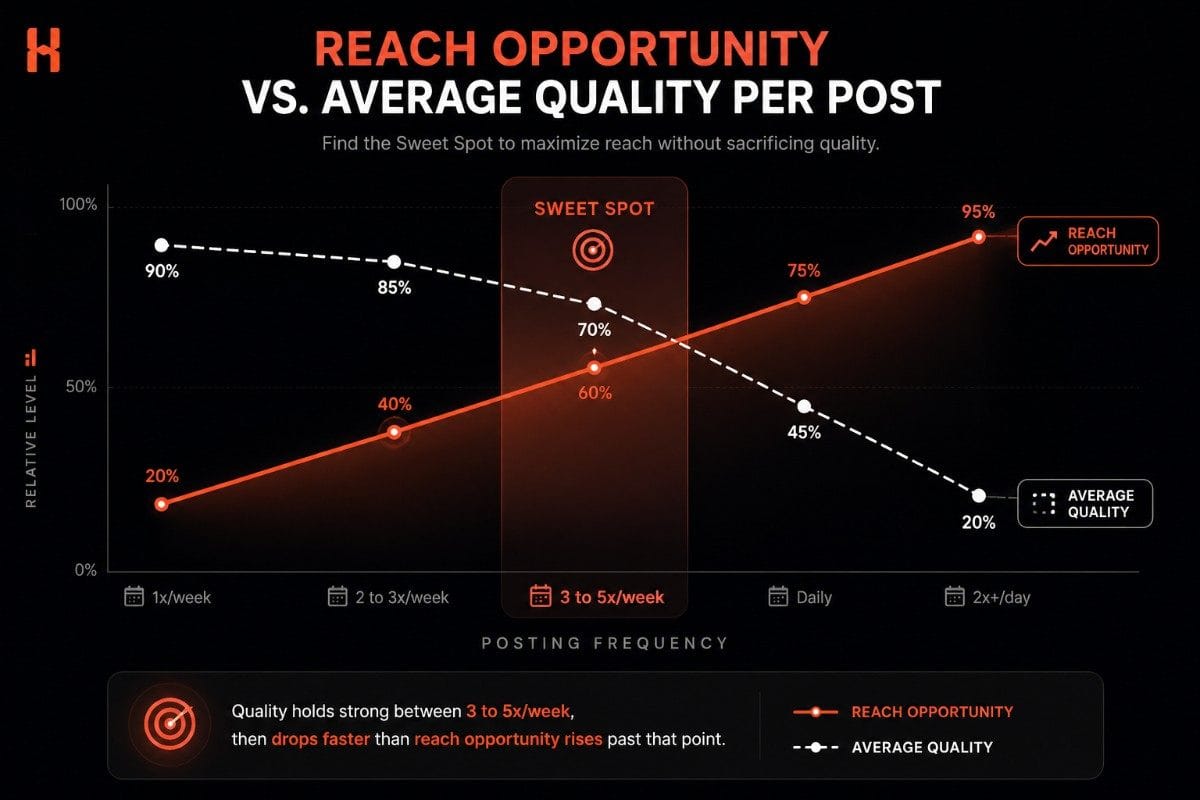
Plotted against each other, reach opportunity and average quality per post move in opposite directions as frequency climbs. Reach opportunity keeps rising, since every additional post is another independent shot at the algorithm. Average quality per post holds fairly steady through a few posts a week, then falls off once frequency outpaces what a creator or team can actually sustain. For most solo creators and small teams, that drop-off starts well before daily, somewhere in the gap between 3 to 5 times a week and posting every day.
What to do instead
For almost everyone past the first couple of months, 3 to 5 posts a week beats daily posting held over any real length of time. A creator who keeps that pace for a year will typically out-grow one who posts daily for a few months and then burns out and goes quiet, since TikTok appears to reward the account that stayed consistent over the one that started strong and disappeared.
Track two things as you settle on a cadence: whether your follower growth is actually moving in the direction you want, and whether your engagement rate is holding steady or slipping as you adjust frequency up or down. A dropping engagement rate alongside a higher posting frequency is usually the clearest sign that volume has outrun quality.
Quick answers
Does posting once a day hurt your TikTok reach? No, posting once a day is generally fine and will not hurt reach on its own. The risk is not the single daily post itself, it is treating daily posting as a fixed quota that pushes out rushed, lower-quality videos over time.
How many times a day is too many on TikTok? Past 4 to 5 posts in a single day, most sources point to diminishing returns and a higher chance of triggering spam-style throttling. Same-day posts can also cannibalize each other's reach, so spacing multiple posts by at least 3 to 4 hours matters more than the raw count.
Should a brand-new TikTok account post every day? It can help. New accounts with under roughly 1,000 followers tend to benefit from posting once or twice a day for their first 30 to 60 days, since there is almost no algorithmic history yet and more attempts help TikTok learn who to show the content to.
Is it better to post once a day consistently or in bursts? Consistency wins. An account that posts 3 to 5 times a week for a year will typically outperform one that posts daily for a few months and then goes quiet, since TikTok appears to reward accounts that maintain a steady, predictable pattern over time.
Turning this into an actual schedule
Once you have settled on a cadence lower than daily, the practical challenge shifts from deciding how often to actually remembering to do it. Can You Schedule Posts on TikTok? Full 2026 Guide covers how to lock a schedule in ahead of time instead of relying on posting live every day.