
How Long to Wait Between TikTok Posts
Posting too close together makes your own videos compete for the same slice of your audience, since TikTok rarely shows two posts from the same account to the same viewer in a short window.

For most accounts, 3 to 4 hours is the minimum gap worth leaving between TikTok posts. Posting too close together makes your own videos compete for the same slice of your audience, since TikTok rarely shows two posts from the same account to the same viewer in a short window. The right gap also depends on how the first post is actually performing, not just the clock.
Updated September 2026
This is about the gap between individual posts, not how many times to post overall. How Often Should You Post on TikTok? and Should You Post Every Day on TikTok? cover the bigger frequency questions. This one is specifically about spacing.
The same-day posting table
| Scenario | Recommended gap |
|---|---|
| Posting 2 times today | At least 3 to 4 hours apart |
| Posting 3 to 4 times today | At least 3 to 4 hours between each |
| First post already taking off | Wait longer, 6 to 8 hours, before posting again |
| First post underperforming after about 2 hours | Safe to post again sooner |
Why posting too close together backfires
Every new video runs through an initial test phase, where TikTok shows it to a small sample audience to decide how far to push it. Posting a second video before that test phase finishes forces a choice: TikTok rarely distributes two videos from the same account to the same viewer's FYP within a short window, unless that viewer is already a superfan. The two posts end up splitting the same pool of attention instead of each getting a clean, independent test.
This is not just theory. One analysis of accounts spacing content by at least 3 to 4 hours found a 22% higher average engagement rate per video compared to accounts posting hourly. The gap is not about being polite to your audience, it is about giving each video room to actually be evaluated before the next one arrives.
The adaptive approach: let the first post decide
A flat rule like "always wait 4 hours" misses something a more adaptive approach catches: the right gap depends on how the last post is actually doing, not just the clock. This approach, sometimes called pulse posting, treats the gap as dynamic rather than fixed.
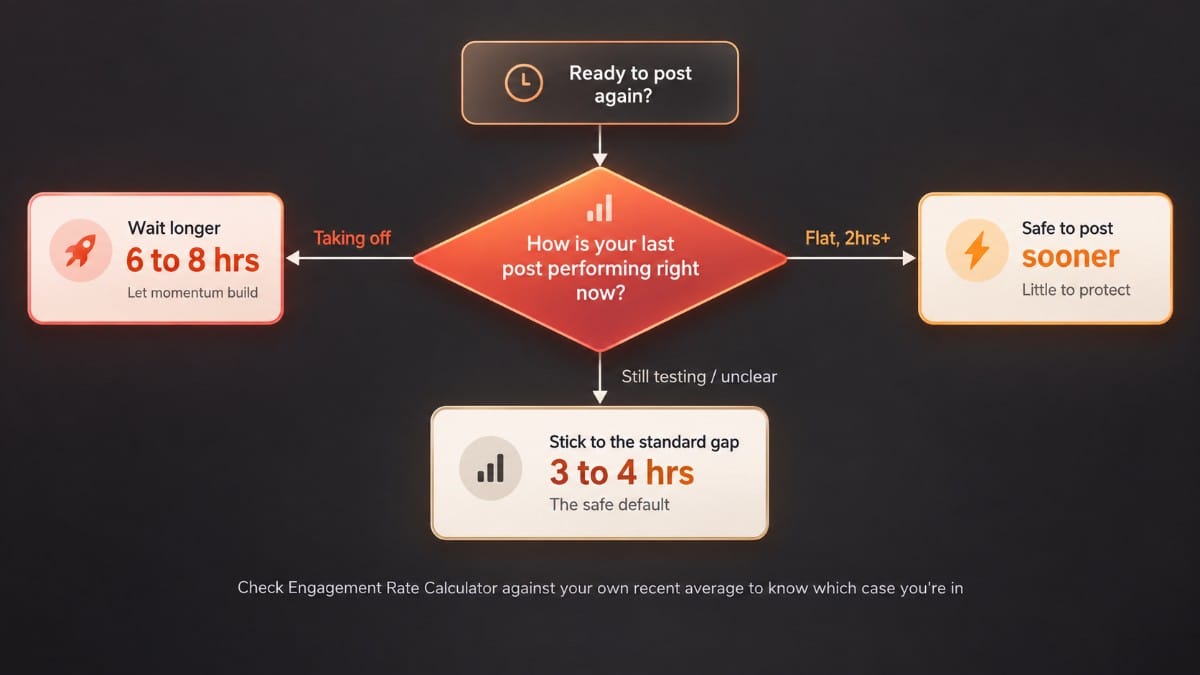
If your last post is clearly taking off, gaining views and engagement quickly, it is worth waiting longer, 6 to 8 hours, before posting again, so the new post does not cut off momentum that is still building. If the last post is flat after about 2 hours with little traction, there is less to protect, and posting again sooner carries less risk. Checking Engagement Rate Calculator against your own recent average is a quick way to tell which situation you are actually in before deciding.
Building this into an actual schedule
Knowing the rule is one thing, actually sticking to it across a busy week is another. Handler's TikTok Posting Schedule Generator can help you lay out a realistic cadence with the gaps already built in, rather than trying to track spacing manually post by post.
Don't confuse hours with days
Spacing within a single day is a different question from how long a single video keeps getting tested. TikTok continues pushing a video for several days after it posts, sometimes longer, so a slow first hour is not a reason to panic-delete or rush out a replacement. The hours-apart guidance above is about same-day posting specifically, not about how quickly you need to follow up if one video starts slow.
Should you wait, or post again? A quick decision flow
Quick answers
Is there a minimum time you have to wait between TikTok posts?
TikTok does not enforce a hard minimum, but most data points to around 3 to 4 hours as the practical floor. One analysis found accounts spacing posts by at least 3 to 4 hours saw a 22% higher average engagement rate per video than accounts posting hourly.
Do TikTok posts really compete with each other if posted too close together?
Yes. TikTok rarely shows two videos from the same account to the same viewer's FYP within a short window, unless that viewer is already a superfan. Posting too close together splits your own audience's attention across two posts instead of giving either one a clean test.
Should I wait longer if my last TikTok is doing well?
Yes, this is the core idea behind an adaptive approach sometimes called pulse posting. If a video is already gaining traction, waiting 6 to 8 hours lets it keep building momentum instead of competing with a new post. If it is clearly underperforming after a couple of hours, posting again sooner carries less risk.
Written by the Handler Team