App Demo or Talking Head? TikTok for Education Apps
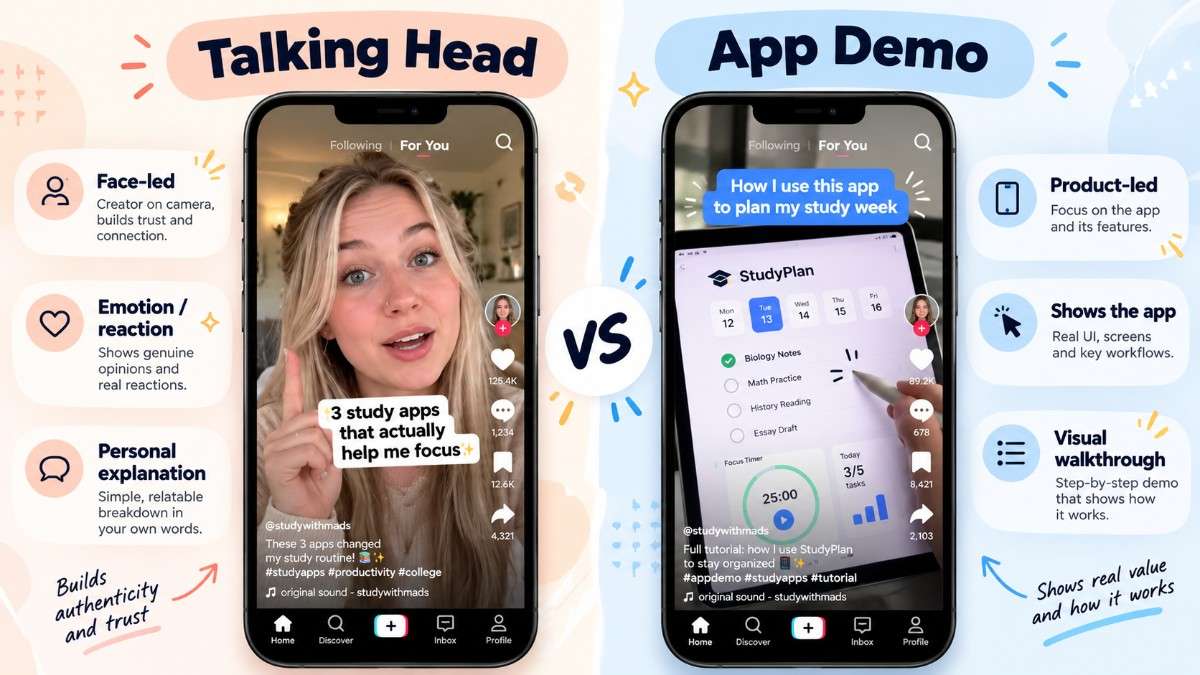
Short answer: In Handler's education library, the top 10 App Demo outliers have a higher median Outlier Score than the top 10 Talking Head outliers (10,969x against 2,466x). On Pull, the two formats are level: the 10 highest-Pull posts in each format all score 5/5. Neither format wins everywhere.
Key points
- This compares 40 real posts in four samples of 10, not every education post in the library.
- Views are close: the median top App Demo has 4.8M views and the median top Talking Head has 4.2M.
- The highest-Pull posts are much smaller than the biggest outliers. Their median Outlier Score is 38x for App Demo and 25.5x for Talking Head.
- The 10 highest-Pull App Demos run a median of 9 seconds. The 10 highest-Pull Talking Heads run a median of 40 seconds.
- This is a comparison of real posts, not an experiment.
Which format wins for education apps on TikTok?
By Outlier Score, App Demo wins this comparison. By Pull, it is a tie. Handler's library lists App Demo as the most common breakout format among recent education outliers, at 36%, and Talking Head at 29%.
Each row below is 10 posts from Handler's education library, read on 29 October 2026.
Sample of 10 | Format | Median Outlier Score | Median views | Median saves per view | Median length | Posts at 5/5 Pull |
|---|---|---|---|---|---|---|
Highest Outlier Score | App Demo | 10,969x | 4.8M | 1.2% | 21 s | 9 of 10 |
Highest Outlier Score | Talking Head | 2,466x | 4.2M | 1.3% | 26 s | 8 of 10 |
Highest Pull | App Demo | 38x | 34K | 7.5% | 9 s | 10 of 10 |
Highest Pull | Talking Head | 25.5x | 136K | 8.3% | 40 s | 10 of 10 |
How to read it. Outlier Score is a post's views divided by its account's own baseline, so it measures how far a post beat its account. The App Demo sample has six posts above 10,000x and the Talking Head sample has two. That is most of the gap in the medians.
Views are close, and so are the baselines. Dividing views by Outlier Score gives a median baseline of about 830 views for the App Demo sample and about 1,050 for the Talking Head sample. This is our arithmetic on rounded view counts.
What does an App Demo TikTok look like for an education app?
A 25-second, silent screen recording of a flight-themed study timer reached 12M views at 14,427x, and 150K people saved it. See the full breakdown.
What happened. The post by @idkjustrant, from April 2026, opens straight on the timer interface and has no spoken dialogue. Short on-screen text points out key actions. Three steps follow at an even pace: start a focus session, watch the travel-themed progress screens, then open the customization settings. The app stays full screen the whole time, with finger taps guiding the viewer, and the clip ends on a running countdown. The account normally reaches about 839 views. This post reached 12M, with 725K likes, 855 comments, 19K shares and 150K saves.
Why it likely worked. Saves outnumbered shares by about 8 to 1, and Pull is 5/5. Handler's read of the post is that the look and the travel theme carry a satisfying payoff from seat selection to boarding pass. Handler's comment read adds a caution: viewers liked the look, but some asked what the app actually does. This is our reading of the numbers, not something the library proves.
Not every App Demo is screen only. By Handler's own hook descriptions, at least 7 of the 10 highest-Outlier App Demos open with a person, a skit or a reaction before they cut to the screen. This study timer does not: it is on screen from the first frame.
What does a Talking Head TikTok look like?
A 41-second, single-shot rant about a school platform reached 5.9M views at 1,808x, with 156K shares and 143K saves. See the full breakdown.
What happened. The post by @studywittt2, from April 2026, is one continuous shot of a person talking to the camera, with no scene cuts and no B-roll. The speaker opens with a confrontational hook about frustration with a learning platform. Three spoken beats follow: how that platform's scoring works, a pivot where the speaker pulls out a phone to use a flashcard app, and a closing comparison of two school platforms. Auto-captions track the speech. The flashcard app is named in dialogue about two-thirds of the way in, and the page describes no app footage. The account normally reaches about 3.3K views. This post reached 5.9M, with 899K likes, 14K comments, 156K shares and 143K saves.
Why it likely worked. Shares and saves are almost level, 156K against 143K, and comments reached 14K, so the post moved people to pass it on, keep it and reply. Its Pull Score is 5/5, and its reach ranks in the top 6% of 902 tracked education outliers. Handler's summary of the format is to vent about a frustrating school platform, then position your app as the stress-free alternative. This is our reading of the numbers.
A caution for your own version. The original names real third-party products. A rebuild should talk about your own app and avoid disparaging named competitors.
What do the highest-Pull posts of each format look like?
They are small, save-heavy posts, and the two formats do different jobs. Among the 10 highest-Pull posts in each format, the median post has 34K views for App Demo and 136K for Talking Head, and viewers saved about 8 in every 100 views.
- App Demo, short and trend-led. Five of the 10 run 6 seconds or less, and the median is 9 seconds. By Handler's hook descriptions, six use an exam-affirmation or "manifestation" trend, such as an "I will pass" chant, before a quick screen recording of a quiz or flashcard tool.
- Talking Head, longer and list-led. The median is 40 seconds, and four run 59 seconds or longer. By the same descriptions, six are a resource list, a study routine or a timeline roadmap that a viewer would want to keep.
This fits a simple idea we have not tested: short trend clips can be saved as a quick idea to copy, and longer lists are saved to use later. It is a reading of 20 posts, not a rule.
The highest-Pull sample is also not a ranking. All 20 posts score 5/5, so the order within each sample is not meaningful.
Does the answer change for language learning, study tools and AI tutors?
We cannot say from this sample. With 10 posts per sample, most niche labels have only one to three posts, which is too few for a median.
What the niche labels do show:
- App Demo, highest Outlier: seven of the 10 are study or writing tools, with labels such as AI Study Tools, AI Study Assistant, AI Essay Bypass, AI Writing Detection or Academic Writing Hacks. One is language learning and two are timer or productivity apps.
- Talking Head, highest Outlier: the mix is wider. Two are Bible Study, two are Language Learning, and the rest are AI Study Assistant, study tools, homework help, brain training and student organization.
- Highest Pull, both formats: exam preparation, college productivity and study tools dominate the labels.
The library's Education label is broader than study apps. Bible study posts sit under it, and the largest Talking Head outlier here is one.
Which format is easier to rebuild with your own AI creator?
Talking Head is easier to rebuild end to end, because the whole video can be made in DupeFarm. An App Demo also needs your own screen recording. That is our reading of how the two formats map to Handler's tools.
- Talking Head: use a Premium Dupe, which is a fresh take on the original with an optional voiceover, and let your AI creator deliver the lines. A Motion Dupe is always silent, so it cannot carry speech. Keep the single continuous shot and the auto-captions that the 1,808x post used, and talk about your own app.
- App Demo: you record your own app's screens, and DupeFarm and your AI creator handle the on-camera part and the overlay kit. A screen-only demo like the study timer needs little more than your recording and the overlay kit.
- Overlay kit: in both cases it is the brand text overlay, caption, hashtags and sound instruction, added as a separate layer.
If you use an AI creator, label the video as AI-generated when you post. Can an AI Creator Front Your Fitness App's TikToks? covers TikTok's current labeling rules.
What does this comparison not prove?
It does not prove that one format causes better results. It compares four samples of real posts, with no control for the account, the product or any paid promotion.
- Small samples. Each row is 10 posts out of roughly 900 in the education library. A different 10 would give different medians.
- Ranked samples, not averages. The highest-Outlier posts are the top of the library by definition, so their medians say how big the biggest wins are, not what a typical post gets.
- Small baselines inflate multiples. The typical account in the highest-Outlier samples normally reaches about 800 to 1,050 views. A moderate result on such an account scores very high.
- Views are not installs. None of these scores measure downloads.
- The Pull samples have ties. All 20 posts score 5/5, so the order within a sample means nothing.
- Labels are broad. An App Demo may open with a person or a skit, and a Talking Head may show the app. The label is the library's.
- Hook counts are readings. The counts such as 7 of 10 come from Handler's written hook descriptions, not from watching each video again.
- No date control. The posts were published at different times, and the library changes as new posts are scored.
- Pull is reported as shown. We use the library's 1 to 5 rating and set no thresholds of our own.
- The rebuilds are untested here. They show how the formats map to DupeFarm and promise no result.
See the scores for your niche
Disclosure: Handler publishes this post and sells the tools it describes. Handler finds outlier TikToks in your niche, scores each one for Outlier and Pull, and lets DupeFarm rebuild the ones you pick with your own AI creator. You can start free, and your first 6 picks are on us. Start free at gethandler.ai or browse the education outlier library.
How we measured
- Outlier Score is a post's views divided by the account's own baseline, the median of its recent views. The Outlier Calculator lets you work it out by hand from the median of an account's last 10 to 30 posts.
- Pull Score is a 1 to 5 rating of how strongly a post moved viewers to save, share or comment, with saves and shares weighted most.
- Samples. On 29 October 2026 we read Handler's education library for App Demo and Talking Head posts, sorted by Outlier Score and by Pull Score, and took the first 10 of each. That is 40 posts.
- Calculations. Medians, saves per view and implied baselines are our own arithmetic on the library's figures, which round views and scores.
- Examples. The two teardowns use the posts' public library pages.